Online Healthcare Training: What Should You Actually Look For?
Searching for an online healthcare course can quickly become confusing. Programs may differ in length, delivery format, practical training, certification, recognition, and total cost. If you want a course that is both convenient and useful for a future healthcare role, compare the complete training pathway rather than choosing the shortest or cheapest option.
You Want a Healthcare Career Without Starting From Zero
You don't necessarily want to spend several years in school.
You may simply want a practical way to build healthcare skills and find out whether the field is right for you.
That is why online healthcare training is attractive.
You can potentially learn from home, study outside normal working hours, and avoid committing immediately to a long full-time program.
But there is a problem.
The course that is easiest to start may not be the course that takes you closest to your actual career goal.
Before comparing prices, you need to answer one question:
What do you expect the course to do for you?
Three Different Reasons People Take Healthcare Courses
Not everyone searching for healthcare training wants the same outcome.
Learning
You may simply want to understand basic patient care, elderly care, healthcare terminology, safety, or related subjects.
For this goal, a flexible online course may be enough.
Career exploration
You may be considering a career change and want to learn the basics before making a larger commitment.
Here, course length and flexibility can become especially important.
Career preparation
You may already know that you want a healthcare support role and are looking for training that fits the requirements of that occupation.
Now recognition, practical training, assessment, and local requirements become much more important.
These three goals can lead to very different course choices.
Why “100% Online” Sounds Better Than It Sometimes Is
Imagine two programs.
Program A:
100% online, self-paced, short completion time.
Program B:
Online theory, followed by practical training and supervised experience.
If your only goal is convenience, Program A may look better.
If your goal involves hands-on patient care, Program B may be more relevant.
Neither description tells you which program is right by itself.
The important question is what the course is designed to accomplish.
Healthcare isn't purely theoretical.
For some roles, you may need to demonstrate practical skills rather than simply pass online lessons.
So when a course advertises itself as “online,” check whether that means:
- Fully online
- Online theory only
- Online plus practical training
- Online plus supervised placement
- Online preparation for a separate qualification
Those are very different products.
Fast, Flexible and Useful — Can You Have All Three?
This is the central problem with online healthcare training.
You want to:
Finish quickly.
You want to:
Study around your life.
And you want:
Training that has real career relevance.
The more practical or formally recognized the pathway becomes, the more likely it is that additional requirements will appear.
You may need practical sessions.
You may need an assessment.
You may need supervised experience.
You may need to meet requirements specific to your location.
That doesn't make online learning less useful.
It simply means that online learning and professional qualification are not necessarily the same thing.
Don't Let “Accredited” End the Research
Words such as “accredited,” “certified,” and “recognized” can sound reassuring.
But you still need to know what they mean in the context of the specific course.
Ask:
Who provides the recognition?
What exactly is being certified?
Is it a course completion certificate or part of a professional qualification?
Does the program satisfy the requirements of the occupation you are targeting?
Are there additional examinations or practical requirements?
This becomes even more important if you plan to work in another country later.
Healthcare job titles and qualification systems aren't identical across English-speaking countries.
Don't Compare Tuition — Compare the Complete Cost
A course advertised at a low price can become more expensive if important requirements are excluded.
For each program, calculate:
Tuition
Practical training
Assessment/examination
Registration or certification fees, if applicable
Equipment and materials
Travel or attendance costs
This gives you a much better comparison.
A flexible program can also have a different “cost” in terms of time.
A self-paced course may fit around work more easily.
A fixed schedule may require fewer weeks overall.
So there are actually two costs to consider:
Money and time.
What Should You Search For?
Once you know the type of healthcare role you are interested in, your search becomes much more specific.
Instead of searching only:
online healthcare course
you can compare terms such as:
online healthcare assistant course
nursing assistant training
healthcare certification online
care assistant training
online caregiver course
healthcare course requirements
accredited healthcare training
healthcare assistant qualification
These searches can help you understand not only what courses are available, but what each type of program is designed to provide.
Build Your Own Shortlist
You don't need to compare twenty programs.
Start with several that appear relevant and put them into a simple table.
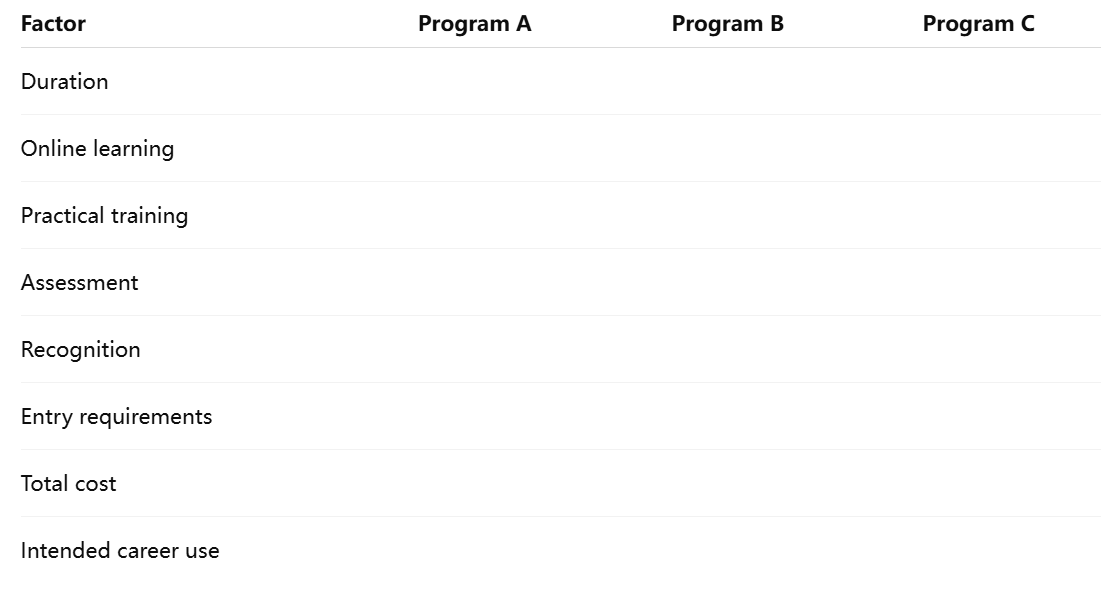
This makes the trade-offs much easier to see.
A course that looked attractive because it was inexpensive might require additional training.
A course that looked inconvenient might include practical components that you would otherwise have to arrange separately.
A course that looked professional might not be intended for the occupation you had in mind.
The Three Questions That Matter Most
Before paying for any online healthcare program, answer these:
1. Can I realistically complete it?
Consider the duration, schedule and workload.
2. Can I use it for what I actually want to do?
Check recognition, practical requirements and the intended occupational pathway.
3. Is the total investment worth it?
Consider both money and time.
If the answer to all three is clear, you are in a much better position to compare programs.
The Goal Isn't the Certificate
A certificate can be useful.
But the certificate itself shouldn't be the entire goal.
If you're exploring healthcare, an online course can help you build knowledge and decide whether the field suits you.
If you're preparing for a specific healthcare support occupation, the important issue is whether the training fits the requirements of that occupation.
And if you need flexibility because you already work or have other responsibilities, the delivery format becomes part of the decision.
That's why the best way to compare online healthcare training isn't:
Shortest course vs. cheapest course.
It is:
Speed vs. flexibility vs. career relevance — and what you actually need from the program.
Once you know which of those matters most to you, comparing healthcare courses becomes considerably easier.