Don't Chase the Highest Cleaning Pay — Compare the Whole Job
A cleaning job advertising a higher hourly rate can catch your attention immediately. But there is a problem with comparing jobs that way. A position paying more per hour may offer fewer hours, a less convenient schedule, fewer benefits or a much heavier workload. For people looking for an accessible job with limited experience, the better question is: What do you actually get for the time and effort you put in?
Don't Judge a Cleaning Job by One Number
Imagine scrolling through several listings.
One says:
$18/hour
Another says:
$21/hour
Another says:
$24/hour
The $24 position looks like the obvious winner.
But you have not seen the full offer yet.
What are the weekly hours?
Is the schedule fixed?
Are nights or weekends required?
Is training provided?
Are there benefits?
How physically demanding is the work?
These details can completely change the comparison.
Example: Three Very Different Offers
Consider these fictional examples:
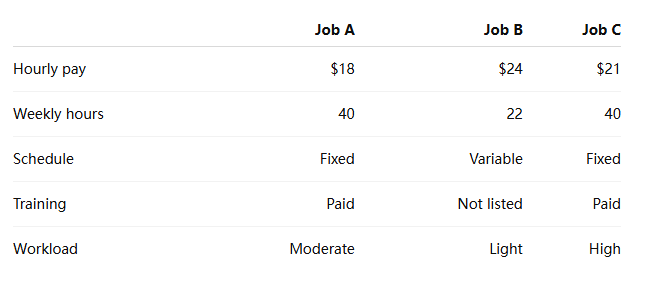
If you only compare hourly pay:
Job B wins.
If you compare weekly gross income:
Job A = $720
Job B = $528
Job C = $840
And if benefits and schedule stability matter, the ranking may change again.
These numbers are simply an example of how to evaluate an offer; actual wages and conditions vary by employer and location.
Full-Time Hours Can Change the Equation
A higher hourly wage is useful only for the hours you actually receive.
For someone who wants a regular full-time schedule, a slightly lower hourly rate with consistent hours may be more attractive.
For someone who already has another job or only wants part-time work, a higher hourly rate with fewer hours could make more sense.
This is why “highest paying cleaning job” is not necessarily the same thing as “best cleaning job.”
Benefits Are Part of the Offer
Benefits can be easy to overlook when comparing job listings.
Depending on the employer, a cleaning position may include things such as:
- Paid training
- Paid time off
- Paid holidays
- Health benefits
- Retirement contributions
- Performance bonuses
- Tips
- Uniforms
- Equipment or supplies
- Transportation support
Current job listings show that some employers combine entry-level hiring with paid training, paid time off and other benefits, while others offer different combinations.
That means two positions with similar hourly wages can have very different overall value.
Workload Matters More Than It Looks
Cleaning is physical work.
Two jobs with the same hourly rate can feel completely different.
For example:
Office cleaner
May involve repetitive cleaning of offices, kitchens, bathrooms and common areas.
Hotel housekeeper
May involve repeatedly preparing guest rooms, changing linen and moving between rooms.
Residential cleaner
May involve travelling between homes and cleaning kitchens, bathrooms, bedrooms and living areas.
Facility cleaner
May involve larger public areas, equipment and more extensive spaces.
None is automatically better.
The question is whether the workload matches the compensation.
The Schedule Can Be Worth Money Too
Consider two positions:
Position A
Monday–Friday
Daytime
40 hours
Position B
Rotating schedule
Evenings
Weekends
25–30 hours
If both have similar hourly pay, Position A may be significantly more convenient for someone who wants a stable routine.
But someone who prefers evenings or needs fewer hours may prefer Position B.
Cleaning work can involve daytime, evening, overnight, weekend or rotating schedules depending on the workplace.
So schedule should be treated as part of the job offer rather than an afterthought.
Look for Training if You Are New
If you have little or no professional cleaning experience, training can make a significant difference.
Look for listings that explain:
- Whether training is provided
- Whether training is paid
- Whether equipment is supplied
- Whether you work with a team initially
- Whether there is a defined cleaning process
- What experience is actually required
Some current listings explicitly advertise paid training and no previous professional cleaning experience, while others still prefer experienced candidates.
That distinction matters.
“Experience preferred” is not necessarily the same as “experience required.”
What Does “Good Value” Look Like?
You can think of a cleaning job as having five major components:
Income
↓
Hours
↓
Benefits
↓
Schedule
↓
Workload
For example:
Job A
$19/hour + 40 hours + paid training + fixed schedule
Job B
$23/hour + 24 hours + limited benefits + rotating shifts
Job C
$21/hour + 40 hours + paid training + fixed schedule + higher workload
There is no single correct answer.
But now you have enough information to make an informed comparison.
That is much more useful than simply sorting listings from highest to lowest hourly pay.
Where Different Cleaning Jobs May Fit
If your priority is predictable hours, you may want to pay particular attention to full-time office or facility positions.
If your priority is getting started with limited experience, look for employers that clearly describe training.
If your priority is potentially higher total earnings, compare hours as well as hourly pay.
If your priority is avoiding difficult shifts, check whether nights, weekends or rotating schedules are required.
If your priority is building experience, look at whether the position involves larger facilities, commercial equipment or additional responsibilities.
Your priorities determine which job is actually better.
Don't Ignore the Small Details
Before applying, check the listing for details that can change the real value of the position:
Is the advertised pay a base rate?
Are tips or bonuses guaranteed or performance-based?
How many hours are normally available?
Is training paid?
Are supplies and equipment provided?
Is transportation required?
Are weekends or nights involved?
What physical tasks are expected?
These questions can quickly separate an attractive-looking listing from an opportunity that actually fits your needs.
The Bottom Line
If you are looking for a cleaning job with a low barrier to entry, don't make hourly pay your only filter.
A better comparison is:
Pay + Hours + Benefits + Schedule + Workload
That approach can reveal why a $20/hour position may sometimes be more useful than a $24/hour position—and why a lower-paying position can occasionally offer a better overall package.
The best cleaning job is not necessarily the one with the biggest number in the advertisement.
It is the one where the overall offer makes sense for the work you are being asked to do.